
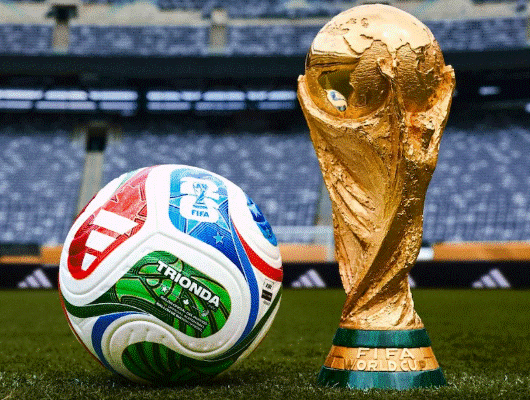

The 2026 FIFA World Cup is not just expanding in teams and host cities. The 2026 FIFA World Cup is also introducing a serious crackdown on time wasting. After ball in play time dropped below 60 minutes in the last tournament, football’s lawmakers decided that the 2026 FIFA World Cup must set a new standard for tempo and fairness.
2026 FIFA World Cup
With the 2026 FIFA World Cup approaching, FIFA and International Football Association Board have officially ratified a package of anti gamesmanship rules. These changes, many tested in Major League Soccer, are designed to make time wasting mathematically disadvantageous during the 2026 FIFA World Cup.
Here is how the 2026 World Cup will look different on the pitch.
The 10 Second Substitution Rule
One of the headline reforms at the 2026 FIFA World Cup targets slow substitutions. We have all seen it before. A team protects a late lead and the substituted player walks slowly across the pitch, draining seconds while the referee watches.
At the 2026 FIFA World Cup, once the substitution board is raised, the outgoing player has exactly 10 seconds to leave the field. They must exit at the nearest boundary line.
If they fail to comply, the substitute must wait for the next stoppage and serve a one minute holding period. During that minute, the team plays one man down.
This is not symbolic punishment. During league trials, almost every substitution happened within the time limit because teams refused to risk being short handed. Expect strict enforcement of this rule throughout the 2026 FIFA World Cup.
Also Read: Italian Football in Crisis as World Cup Fears Intensify
The One Minute Injury Rule
The 2026 FIFA World Cup will also address tactical injury delays. If a player remains on the ground for more than 15 seconds or requires medical staff, they must leave the pitch and remain off for at least one minute of running clock time.
That changes the calculation completely. At the 2026 FIFA World Cup, going down to break momentum could hurt your own team more than it helps.
There are important exceptions. Head injuries are excluded. Goalkeeper injuries are excluded. If the player was fouled and the opponent receives a yellow or red card, the rule does not apply. Even so, the message from the 2026 World Cup authorities is clear. The clock will not be manipulated easily.
The Five Second Restart Countdown
Restarts are another focus area for the 2026 World Cup. Referees will now enforce throw ins and goal kicks with visible five second countdowns.
If a throw in is not taken before zero, possession flips to the opponent.
If a goal kick is delayed beyond five seconds, the opposing team receives a corner kick.
At the 2026 FIFA World Cup, defenders will think twice before wasting time over a goal kick, knowing the punishment brings immediate danger.
The Goalkeeper Eight Second Rule
Goalkeepers at the 2026 World Cup can only hold the ball for eight seconds. If they exceed that limit, the opposition is awarded a corner kick.
Previously, the punishment was an indirect free kick, which referees rarely enforced. The 2026 FIFA World Cup replaces that with a simpler and more impactful consequence.
The Captain Only Zone
To reduce referee crowding and speed up decisions, the 2026 FIFA World Cup will implement a captain only communication policy. Only the team captain may approach the referee regarding a decision. Any other player who swarms the official faces an automatic yellow card.
This measure is designed to protect officials and keep the rhythm of matches intact during the 2026 FIFA World Cup.
Faster VAR Reviews
VAR will also operate under stricter time expectations at the 2026 World Cup. Officials can review incorrectly awarded corner kicks and second yellow cards, but only if the review can be completed immediately without causing long stoppages.
The emphasis throughout the 2026 FIFA World Cup is speed, clarity, and maintaining flow.
A Tournament Built on Tempo
The philosophy behind these changes is simple. Instead of adding excessive stoppage time, the 2026 FIFA World Cup is attacking the root of delays. If teams waste time, they suffer competitive consequences.
The 2026 FIFA World Cup wants more ball movement, more intensity, and fewer interruptions. Coaches will have to adapt. Players will need sharper awareness. Game management will evolve.
If these reforms work as intended, the 2026 World Cup could deliver faster, cleaner, and more engaging football. And if that happens, it may permanently redefine how the modern game protects its tempo at the highest level.