
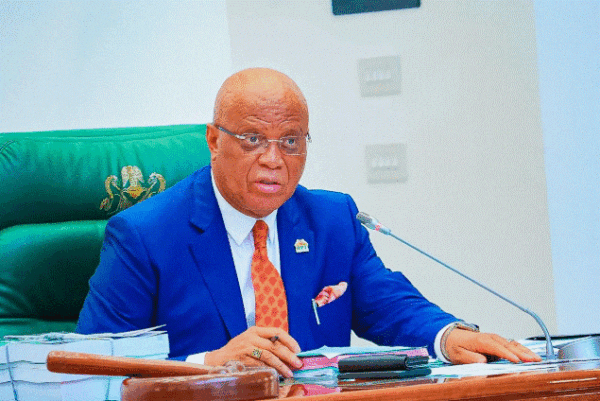

Edet Ikotidem
In recent times, the political environment has been dominated by a rising tide of endorsement, coordinated declarations, and subtle pressures mounted on the electorate by various interest groups.
Endorsement Frenzy, Governance Deficit: Lessons from Akwa Ibom
What should ordinarily be a period for evaluating governance and strengthening public service delivery has instead been overtaken by political theatrics.
The situation becomes even more curious when such endorsements are aggressively pushed despite the fact that, in some political spaces, there is barely any real contest yet. This trend is not only unnecessary—it is deeply unhelpful to the progress of governance.
Endorsement Frenzy
The experience of Akwa Ibom State offers a telling example of why this misplaced priority should concern everyone. While political actors and support groups are busy organizing endorsements and mobilizing public displays of loyalty, critical governance issues are beginning to surface—issues that directly affect the daily lives of ordinary citizens.
Take, for instance, the issue of gratuity payments to retirees. Not too long ago, there was commendable progress in the prompt settlement of gratuities, giving hope to civil servants who had served the state faithfully. However, recent observations suggest that the speed of these payments has slowed down. Retirees, many of whom depend entirely on these benefits for survival, are once again finding themselves in a state of uncertainty.
For a government that had built goodwill around addressing this backlog, any regression in this area raises legitimate concerns.
Electricity supply is another pressing challenge. Across several parts of Akwa Ibom, residents and business owners continue to grapple with inconsistent and, in some cases, near-absent power supply. This is not a minor inconvenience—it has real economic implications. Small businesses struggle to operate, artisans incur higher costs running generators, and households face declining living standards. When power supply remains unreliable, it stifles productivity and discourages investment, undermining the very foundation of economic growth.
Then there is the persistent issue of fuel prices. Despite broader national dynamics influencing petroleum costs, the reality on the ground is that citizens are paying more to power their vehicles, businesses, and homes. In a state where many depend on transportation and small-scale enterprises for their livelihood, higher fuel prices translate directly into increased cost of living. Food prices rise, transport fares increase, and the average citizen bears the burden.

These are not abstract policy debates—they are real, everyday challenges. And they highlight a fundamental truth: governance cannot take a back seat while politics takes the front row.
This is why the current wave of endorsements appears not only premature but also misplaced. Instead of focusing energy on promoting political ambitions, stakeholders—especially those already in positions of authority—should concentrate on addressing these pressing issues. Governance is not something to be paused or sidelined in anticipation of future elections. It is a continuous responsibility that demands attention, discipline, and commitment.
Youth groups, in particular, must begin to rethink their role in this unfolding scenario. Too often, young people are mobilized as instruments of political endorsement, participating in rallies, issuing statements, and amplifying agendas that may not necessarily serve their long-term interests. While political participation is important, it should not come at the expense of productivity and self-development.
Also Read: Aides: Internal Political Factors Likely to Influence Governor Umo Eno’s Stance in 2027
Akwa Ibom, like many other states, is rich in opportunities—especially in agriculture and enterprise. Instead of investing time and energy in endorsement campaigns, youth groups could channel their efforts into farming, agro-processing, skill acquisition, and entrepreneurship. These are ventures that not only provide immediate economic benefits but also contribute to food security and sustainable development.
Imagine a scenario where the same level of organization and enthusiasm seen in political endorsements is redirected toward cooperative farming initiatives, tech startups, or local manufacturing. The impact would be transformative. Employment would increase, poverty would decline, and young people would gain a sense of ownership over their future.
Moreover, youth groups have a powerful voice that can be used more constructively. Rather than merely endorsing leaders, they should hold them accountable. They should ask questions about the slowdown in gratuity payments, demand solutions to the electricity crisis, and seek clarity on measures to cushion the impact of high fuel prices.
This is the kind of engagement that strengthens democracy and ensures that leadership remains responsive to the needs of the people.
Political leaders, on their part, must also exercise restraint. Encouraging or entertaining early endorsements can create the impression that political ambition is taking precedence over public service. True leadership is demonstrated not through the number of endorsements received, but through the quality of governance delivered. Roads, schools, healthcare, power, and economic opportunities—these are the real metrics by which leadership should be judged.
The electorate, too, must remain discerning. Citizens should resist the temptation to be swayed by the noise of endorsements and instead focus on tangible outcomes. Has governance improved? Are lives getting better? Are critical challenges being addressed? These are the questions that should guide political decisions.
The situation in Akwa Ibom serves as a cautionary tale. It reminds us that when politics becomes too loud, governance can become too quiet. And when governance suffers, it is the people who pay the price.
The way forward is clear. Let there be a deliberate shift in focus—from endorsement to performance, from political pressure to public service, and from distraction to delivery. Let leaders settle down and govern with purpose. Let youth groups invest their energy in productive ventures that build both personal and collective prosperity. And let the people insist on accountability, refusing to be carried away by the noise of premature political campaigns.
In the end, it is not endorsements that will define the future of Akwa Ibom—or any society—it is the quality of leadership and the effectiveness of governance. And that is where all attention should be directed.

