


By Edet Ikotidem
The Chairman of Ukanafun Local Government Area, Prince Uyo Ukpanah, has reaffirmed his commitment to the development and transformation of the area, stressing that his administration is determined to improve the living conditions of residents and create an environment where communities can thrive.
“I Am Committed to the Development of My Community,” Uyo Ukpanah Tells ANPA
Prince Uyo Ukpanah made the statement when the Amalgamated Newspaper Publishers Association (ANPA), Akwa Ibom State, embarked on a fact-finding tour of the local government area to assess ongoing development efforts and interact with stakeholders and residents.
During the visit, the chairman explained that his administration views local government as the closest level of government to the people and, therefore, must remain responsive to the needs and aspirations of the communities it serves. He noted that development should not be measured only by the number of projects completed but also by the positive impact such projects have on the daily lives of ordinary people. According to him, his administration is focused on pursuing practical initiatives that will address pressing challenges in the communities while laying the foundation for sustainable growth.
He emphasized the importance of improving basic infrastructure, supporting education, promoting healthcare, empowering young people and women, and creating opportunities for local economic development. One of the areas receiving attention, he explained, is the improvement of community infrastructure. Good roads, accessible public facilities, electricity, water and other basic amenities are essential to economic and social development. Prince Ukpanah stated that his administration would continue to identify areas where government intervention is most urgently required and work toward providing solutions within available resources.
I Am Committed to the Development of My Community
The chairman also highlighted the importance of education in the development agenda of the local government. He noted that no community can achieve meaningful progress when its children and young people lack access to quality education. According to him, investment in schools, learning facilities and educational support is an investment in the future of the entire local government.
He further stressed the need to create an enabling environment for young people to acquire useful skills and become economically productive. Youth empowerment, he said, should go beyond political rhetoric and should involve practical programmes that equip young people with skills capable of helping them establish businesses, secure employment and contribute positively to their communities.  Women empowerment is another area the chairman identified as important to community development. He acknowledged the significant role women play in the economic and social life of the communities and expressed his administration’s willingness to support initiatives that can improve their economic independence and participation in local development. Healthcare, according to Prince Ukpanah, also remains an important component of his administration’s priorities.
He explained that access to basic healthcare should not be regarded as a privilege but as a necessity for every resident. Strengthening primary healthcare facilities and improving awareness about preventive healthcare are among the measures that can help improve the wellbeing of the people. The ANPA fact-finding tour led by irs Presidennt OsuniAbasi Alfred provided an opportunity for the newspaper publishers to observe the realities on the ground and hear directly from the people. 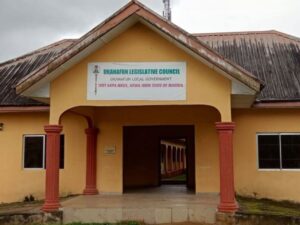 Among the projects inspected was the state-of-the-art administrative block named after the late Obong (Barr.) Asuquo J. Ukpanah.
The team also inspected the completed and furnished Women Development Centre, which houses the Office of the First Lady and is named after the late Governor’s wife, Mrs. Patience Umo Eno. Another major facility inspected was the 20-room office complex equipped with facilities intended to improve staff convenience and productivity.
The remodeled and furnished Legislative Chamber was also inspected, alongside the 100KVA Mikano generator serving the council secretariat. The Traditional Rulers Council Secretariat, which is still under construction and nearing completion, also attracted the attention of the visiting publishers.
The facility includes offices for the Secretary of the Traditional Rulers Council and staff, reflecting the administration’s recognition of the traditional institution as an important partner in grassroots governance. Outside the council headquarters, the administration presented a number of interventions spread across the 13 wards.
These include the grading of roads across the wards to improve inter-community movement and transportation; construction of a Primary Healthcare Centre at Ikot Ebok; provision of solar-powered boreholes in Nsekhe, Odoro Ikot, Ikot Esa and Ikot Oku Usung; acquisition of land for a proposed stadium project; grants to law students; and full sponsorship of the coronation of the Paramount Ruler. The administration also highlighted the ongoing construction of the Udo Ekpenyong Unity Hall, completion of a state-of-the-art conference room, provision of offices for councilors, official vehicles for the Secretary to the Council and Legislative Leader, as well as official vehicles already provided for six aides to the Council Chairman.
For a rural local government where road connectivity and access to basic amenities remain important to residents, the road grading and water projects are particularly significant. A functional road network makes it easier for farmers, traders, students and other residents to move between communities, while access to clean water can have direct implications for public health and household welfare.
Speaking on how his administration had been able to execute the projects, Chairman Uyo Ukpanah explained that the projects were funded from the statutory allocation accruing to the local government. “All the progress you have seen here in Ukanafun is done with the local government allocation. I have not borrowed any money from any quarter, and I am not ready to do so in the near future. Rather, I take my projects bit by bit within the range of what comes in,” he said.
The chairman’s explanation points to an approach centered on working within available resources rather than accumulating debt for the council. According to him, the administration prioritizes projects according to available funds and executes them progressively. Prince Uyo Ukpanah also attached a personal dimension to his development agenda, explaining that Ukanafun was created by his late father in 1976 and that he considers the development of the area both a public responsibility and a way of preserving that legacy.
Beyond personal considerations, however, the chairman said his determination was largely driven by the mandate given to him by the people of Ukanafun. He disclosed that the proposed stadium project is expected to commence in 2027, while bursaries would also be paid to deserving students.
The announcement provides another indication of the administration’s intention to combine physical development with investment in human capital. Perhaps one of the most ambitious plans announced during the assessment was a proposed ₦200 million mega empowerment programme to mark the second anniversary of the administration.
According to the chairman, the empowerment scheme will target citizens with various forms of support, including cars, tricycles, cooking ovens, sewing machines and business grants. If implemented as announced, the programme could provide opportunities for beneficiaries to strengthen existing businesses or establish new sources of livelihood. For an administration operating at the grassroots, such interventions are significant because empowerment programmes can help move government assistance beyond infrastructure to directly impact individuals and families.
Prince Ukpanah said he welcomed constructive criticism and independent assessment of his administration because such feedback could help government identify areas where more attention was required. He maintained that the media has a significant role to play in strengthening democracy by informing citizens, holding public officials accountable and highlighting developments taking place at the grassroots. He therefore urged journalists and newspaper publishers to report the affairs of the local government fairly and objectively, noting that responsible journalism can help attract attention to communities that require government intervention while also encouraging public officials to remain committed to their responsibilities.
The chairman further appealed to residents to support development efforts by protecting public infrastructure and participating actively in community programmes. He noted that government alone could not achieve sustainable development without the cooperation of the people. Beyond physical infrastructure, Prince Ukpanah emphasized the importance of peace and unity. He observed that investors, development partners and government agencies would be more willing to support communities where there is stability and cooperation. He therefore called on traditional leaders, youths, women, religious bodies and community organizations to work together in promoting peace and peaceful coexistence. The chairman’s position reflects a broader understanding of grassroots development: that meaningful transformation must be people-centred, inclusive and sustainable. Roads and buildings may provide visible evidence of development, but true progress is also reflected in improved education, better healthcare, economic opportunities, social stability and the confidence of citizens in their communities.
The President of ANPA, Pastor OsuniAbasi Alfred, described the Council Chairman as a leader passionate about the welfare and development of his people.
Also Read: Ikot Ekpene Village Heads Disown Court Suit Over Clan Head Succession, Reaffirm Support for Due Process
“Council Chairman, on behalf of my members, you have done well. If we, the watchdog, are saying you have done well, then there is no politics about it,” he said. He noted that receiving government allocation was one thing, while using available resources to deliver meaningful development was another. “It is one thing to receive an allocation and another thing to do justice to it. From what we have seen, you came prepared for governance, hence this superlative performance in less than two years,” the ANPA President stated. He encouraged the chairman to sustain the momentum as the administration approaches its third year and continue to make the people of Ukanafun proud.
The ANPA assessment also reinforces an important principle of grassroots governance: citizens ultimately judge government not merely by speeches, promises or political declarations, but by what they can see, touch and experience. A functioning health centre, a graded community road, a reliable water source, a furnished public office, educational support or an empowerment opportunity can have a more immediate meaning to an ordinary citizen than political rhetoric. The administration’s approach also demonstrates that development is multifaceted. While infrastructure provides the physical foundation, staff welfare and functional government offices can improve service delivery. Healthcare interventions address the wellbeing of residents, while educational assistance and empowerment programmes target human capacity and economic independence.
The role of the media in documenting such developments is equally important. ANPA’s decision to undertake an on-the-spot assessment provides an opportunity for the public to hear about government activities through an independent journalistic lens rather than relying exclusively on official claims. At the same time, such assessments can encourage public officials to maintain accountability and ensure that projects are properly executed and sustained.
In her vote of thanks, the Vice Chairman of Ukanafun Local Government Council, Hon. (Mrs.) Aniekan Owen, thanked the leadership and members of ANPA for taking the time to visit the local government. She described the assessment as an encouragement to the administration to deepen its commitment to effective grassroots governance and continue delivering projects that directly affect the people.
As the 2027 political season gradually takes shape, the Ukanafun experience reinforces a simple political truth: at the grassroots, performance remains one of the strongest campaign messages. Political seasons come and go, but roads, healthcare facilities, water projects, schools, empowerment initiatives and functioning public institutions remain part of the everyday experiences of citizens. For Hon. (Prince) Uyo Ukpanah, therefore, the challenge is not simply to celebrate the projects already delivered but to sustain the momentum, complete ongoing projects, expand interventions across the 13 wards and ensure that development reaches more communities.
The ANPA visit has opened another chapter in the public conversation about governance in Ukanafun. More importantly, it has brought the focus back to what should ultimately matter in local government administration: the people, their needs and the tangible transformation of their communities.
If the administration sustains its current direction while maintaining transparency, accountability and equitable distribution of projects, the development story of Ukanafun could become an increasingly compelling example of how focused grassroots leadership can translate limited resources into visible community impact.