

Onyeka Chidi
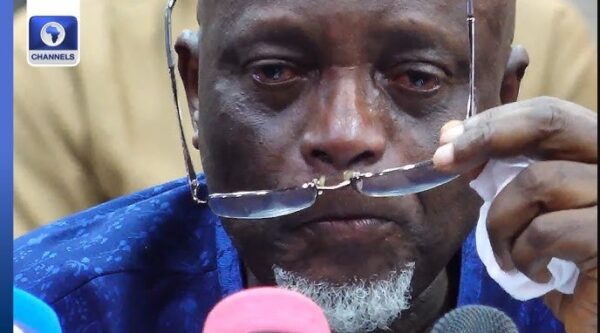
In a deeply emotional and unprecedented moment in Nigeria’s educational history, the Registrar of the Joint Admissions and Matriculation Board (JAMB), Professor Ishaq Oloyede, was moved to tears as he addressed the public regarding a massive technical error that affected this year’s UTME. The board has officially announced that 379,997 candidates will have to rewrite the 2025 UTME due to these technical issues.
During a press briefing held on Tuesday, May 14, 2025, Professor Oloyede admitted the board’s fault and offered a heartfelt apology to all affected students and parents. His voice trembled and eyes welled up as he took full responsibility for the situation, stating, “I apologize and take full responsibility, not just in words. We are not shifting the blame.”
The issue stemmed from serious technical failures caused by faulty server updates from one of JAMB’s ICT service providers. The glitch disrupted the upload of candidates’ answers during the first three days of the UTME in multiple centers across six states: Lagos, Imo, Anambra, Oyo, Abia, and Ebonyi. A total of 157 centers were compromised—65 of them in Lagos alone, and 92 from the Owerri zone.
Also Read: 2025 UTME Crisis: JAMB Launches Urgent Investigation Amid National Outcry
As a result, JAMB has scheduled a fresh examination for the affected candidates to be held between May 16 and May 18, 2025. The board has urged all concerned students to reprint their exam slips for updated details on their new dates and centers.
This announcement has stirred strong reactions nationwide. The Academic Staff Union of Universities (ASUU) has expressed outrage, with the University of Nigeria Nsukka chapter calling for legal redress. ASUU representatives accused JAMB of allowing errors that allegedly disproportionately affected candidates from the South-East, suggesting there may be deeper issues at play.
ASUU-UNN Chairman, Comrade Oyibo Eze, openly challenged the board, saying, “We are watching the situation very closely. We won’t sit back and let our students be victimized. This cannot be swept under the carpet.”
Despite the backlash, some education stakeholders have applauded the board’s transparency. The National Parent Teacher Association of Nigeria (NAPTAN), represented by its National President, Alhaji Haruna Danjuma, praised JAMB for owning up to the failure rather than hiding behind excuses. “This is a difficult moment for students and parents, but JAMB has shown some level of integrity by acknowledging their mistake and taking corrective steps,” he said.
Professor Oloyede’s emotional breakdown has drawn sympathy from many Nigerians. Social media was flooded with messages of mixed feelings—some applauding his honesty, others questioning how such a large-scale error could occur in the first place. Many students shared their frustrations, highlighting the mental stress and disappointment caused by having to rewrite such an important examination.
This is not the first time technical issues have disrupted UTME in Nigeria, but the scale of this incident makes it one of the most serious in JAMB’s history. It threatens to erode public trust in a board that has, in recent years, tried to digitize and modernize Nigeria’s exam system.
JAMB insists that its priority now is to ensure fairness and credibility. The board has promised tighter monitoring, improved infrastructure, and stricter accountability for service providers moving forward. Professor Oloyede reassured Nigerians that lessons have been learned and efforts will be doubled to avoid a repeat of this unfortunate incident.
For the nearly 380,000 affected students, however, the journey is far from over. The next few days will determine not just their exam results, but their educational future. And for many, the memory of watching the JAMB Registrar break down while admitting fault will remain a haunting symbol of how much more needs to be done to strengthen Nigeria’s education system.