
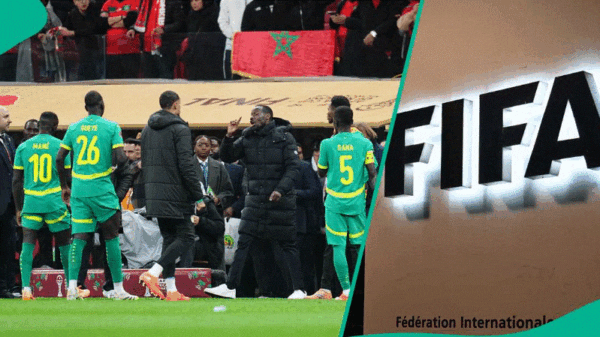

The debate around a possible Senegal World Cup ban has sent shockwaves through African football, stirring anxiety among fans and officials alike. What began as a heated Africa Cup of Nations final has now grown into a global discussion involving FIFA, CAF, and some of the continent’s biggest football powers.

Senegal World Cup Ban
At the heart of the issue is the chaotic ending to the 2025 AFCON final in Morocco. Senegal’s narrow victory should have been a moment of celebration, but instead, it opened the door to controversy that quickly fueled talk of a Senegal World Cup ban across international media.
The flashpoint came late in extra time when a disputed penalty decision triggered intense protests. Senegalese players and members of the technical crew briefly walked off the pitch, forcing officials to halt the match before calm was restored and play resumed.
Scenes of confusion circulated worldwide, and within hours, questions emerged about whether the incident could escalate into a Senegal World Cup ban. The reaction from football authorities was swift, stern, and highly public.
FIFA President Gianni Infantino publicly condemned the behavior, describing it as unacceptable at the highest level of the game. His remarks added fuel to speculation, with many interpreting the statement as a warning shot related to a potential Senegal World Cup ban.
Despite the strong language, FIFA stopped short of announcing any direct punishment against the national team. Instead, responsibility for disciplinary action was handed to CAF, Africa’s governing football body, reducing immediate fears of a Senegal World Cup ban.
CAF confirmed that disciplinary proceedings had been opened, focusing on individual conduct rather than collective punishment. This distinction is critical, as it significantly lowers the likelihood of a full Senegal World Cup ban under FIFA statutes.
Legal experts point out that World Cup bans are rare and typically reserved for extreme cases such as government interference or repeated violent misconduct. Based on current evidence, the threshold required for a Senegal World Cup ban has not been met.
Also Read: African Nations League: Everything You Need to Know
What is more likely are targeted sanctions. These could include fines, suspensions for players or coaching staff, and official warnings. While serious, such measures fall well short of a Senegal World Cup ban and would not erase qualification.
Adding complexity to the situation is Morocco’s response. Reports suggest the Moroccan football federation is exploring legal avenues related to officiating decisions. Even so, these actions are unlikely to trigger a Senegal World Cup ban, according to analysts.
Meanwhile, Senegal remains officially qualified for the 2026 World Cup. Preparations continue behind the scenes, and no formal notice has been issued that would indicate a looming Senegal World Cup ban from FIFA.
The episode highlights a larger issue within African football: the fine line between passion and discipline. As emotions run high on the continent’s biggest stages, governing bodies are under pressure to enforce rules without undermining the sport’s growth or resorting to a Senegal World Cup ban.
For now, the situation remains clear. There is condemnation, there is investigation, but there is no confirmed Senegal World Cup ban. Until CAF concludes its disciplinary process and FIFA takes further steps, any talk of exclusion remains speculation rather than reality.
As African football moves forward, the focus will be on accountability, reform, and restoring trust. Senegal’s fate serves as a reminder that while the margins are thin, the line toward a Senegal World Cup ban has not been crossed.
While the threat of a Senegal World Cup ban dominates headlines, the real story is about accountability and passion. Senegal’s players and staff acted out of frustration, but their brief walk-off also highlighted how high emotions run in African football. Fans are divided between support for the team’s protest and concern about consequences. Experts believe that targeted sanctions are more likely than a full Senegal World Cup ban, focusing on individual behavior rather than punishing the entire squad. The incident may ultimately lead to stronger regulations, making future tournaments fairer and minimizing the risk of chaos on the pitch.