


Imagine a world where your phone never needs a cable, electric cars recharge while driving, and remote villages receive power without a single mile of copper wire. While this sounds like Nikola Tesla’s century-old sketches, Finland is turning this “steampunk” dream into a 21st-century reality with wireless electricity transmission.

Finland Wireless Electricity Transmission
As of 2026, Finnish researchers and tech pioneers have moved long-range wireless electricity transmission from small lab experiments to potentially transformative infrastructure. The breakthroughs promise to reshape how we generate, deliver, and consume power.
At its core, wireless electricity works similarly to Wi-Fi or radio waves—but with much higher energy density. Finnish engineers, especially at Aalto University and the University of Helsinki, are focusing on two key methods: resonant magnetic coupling and superconducting receivers.
Resonant magnetic coupling involves two electromagnetic coils—a transmitter and a receiver—tuned to the same frequency. When they vibrate in harmony, energy tunnels from one to the other through a high-frequency magnetic field. This is a foundational principle behind modern wireless electricity transmission.
Superconducting receivers represent another breakthrough. Using highly efficient superconducting materials, these devices capture energy with minimal loss, overcoming historic inefficiencies where most power would dissipate into the air. Combined, these technologies make wireless electricity transmission far more practical and reliable than ever before.
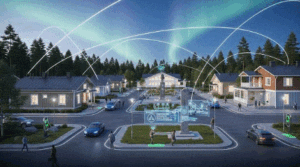
Why Finland? The Nordic country has long been a hub for telecommunications and cutting-edge technology. With expertise in managing high-frequency waves, Finland is well-positioned to pioneer wireless electricity transmission on a practical scale. The nation’s commitment to achieving carbon neutrality by 2035 further fuels innovation in energy flexibility.
Also Read: Don’t Be a Foolish Job Seeker in 2026; Smart Job Hunting Tips That Work
Traditional power lines are costly to build across rugged forests and remote terrain. Wireless electricity transmission offers a grid-less solution that could bring power to areas previously unreachable, reducing environmental impact and infrastructure costs.
The potential applications of wireless electricity transmission are extraordinary. Drones could remain airborne indefinitely by tapping power from ground-based transmitters. Highways could charge electric vehicles in motion, eliminating range anxiety. Even medical implants could be recharged safely through the skin, avoiding invasive surgeries.
Emergency response scenarios could also benefit. In disaster zones where the physical grid is destroyed, wireless electricity transmission could beam power directly to affected areas, providing critical support without waiting for repairs.
Of course, safety is a common concern. Finnish researchers ensure wireless electricity transmission only activates when a recognized handshake occurs between transmitter and receiver. Low-frequency radio waves and shielding prevent harm to humans, wildlife, and electronics, meaning the air won’t become a giant microwave.
Demonstrations in 2025 and early 2026 have proven the feasibility of wireless electricity transmission, marking the beginning of the end for the era of ubiquitous cables. Scaling costs are expected to fall, efficiency will improve, and soon, energy could become as effortless and invisible as Wi-Fi.
The environmental benefits are equally impressive. By reducing reliance on traditional grids and minimizing the need for copper wiring, wireless electricity transmission can lower carbon footprints and enable more resilient, distributed energy networks.
From powering homes and vehicles to enabling continuous drone flight and safer medical devices, wireless electricity transmission promises a radical shift in how humans interact with energy. Finland’s research is laying the groundwork for a future where electricity flows freely, invisibly, and sustainably around us.
The future of wireless electricity transmission promises to transform daily life. Homes, offices, and even public spaces could be powered without plugs or wires, making energy more accessible and flexible. Electric vehicles may recharge as they drive, drones could stay airborne indefinitely, and remote communities could gain reliable power without costly infrastructure. Beyond convenience, the technology could reduce carbon footprints, minimize the need for copper wiring, and create more resilient energy networks. As Finnish research advances, wireless electricity transmission is poised to make energy invisible, seamless, and universally available, turning a century-old dream into practical reality.
In conclusion, wireless electricity transmission is no longer a science-fiction fantasy. With Finnish innovation leading the way, the dream of untethered, seamless electricity is becoming reality. By 2030, the cables that bind us may be relics, replaced by energy that is everywhere and ready whenever we need it.