
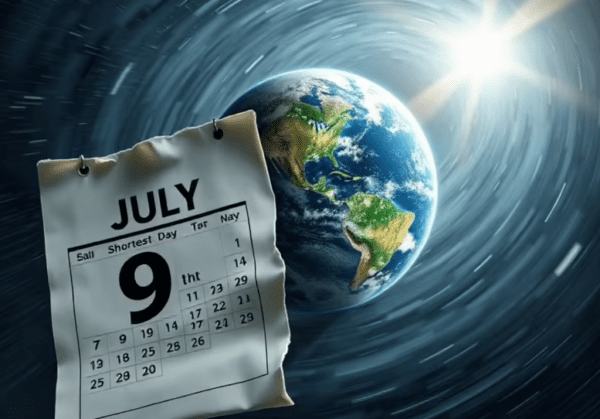

In a jaw-dropping twist that’s leaving scientists stunned, today has officially gone down in history as the shortest day ever recorded on Earth. The planet completed a full rotation faster than ever before—about 1.59 milliseconds shorter than the usual 24-hour cycle. While the change isn’t visible to the human eye, it’s a massive deal for global timekeepers and scientific institutions.

Shortest day ever recorded on Earth
This sudden speed-up means our clocks and Earth’s rotation are no longer perfectly aligned. To correct this, global timing authorities may soon introduce a “negative leap second”—something that has never been done before. Every past leap second added time to match Earth’s slower spin. But now, due to the shortest day ever recorded on Earth, time might need to be taken away.
Also Read: Unlocking the Power of the Kingdom of God: Your Life Will Never Be the Same
Why is this happening? Scientists say the Moon’s gravitational pull is a major reason, but it doesn’t stop there. Other possible factors include changes in Earth’s core, melting glaciers shifting global mass, and even seismic activity. All of these can influence Earth’s rotation and trigger rare events like the shortest day ever recorded on Earth.

Although losing 1.59 milliseconds seems small, in industries like aviation, satellite navigation, telecommunications, and high-frequency trading, every microsecond counts. The shortest day ever recorded on Earth could cause system errors, data misalignments, or GPS glitches if not properly adjusted. That’s why institutions are racing to adapt before more anomalies arise.
Today’s record-breaking rotation also raises questions about Earth’s stability. Some researchers are worried that the shortest day ever recorded on Earth might not be a one-time event. If these shifts continue, it could signal deeper changes in Earth’s structure or behavior that we barely understand yet.
And while the average person won’t notice a millisecond drop, timekeepers around the world are on high alert. Their job is to maintain Coordinated Universal Time (UTC), which guides everything from international flights to internet servers. The shortest day ever recorded on Earth could force a radical decision to subtract time for the first time in history.
Adding to the mystery, scientists say we’re living through an unusual era. Earth has sped up its rotation several times since 2020, but today is the most extreme case. This makes the shortest day ever recorded on Earth not just a scientific headline, but a potential turning point in how we track time itself.
Some theories suggest that melting polar ice is redistributing Earth’s mass, shifting its spin. Others point to deep changes in the molten outer core. Either way, the shortest day ever recorded on Earth is a sign that our planet is constantly in motion—physically and geologically—in ways we’re just beginning to decode.
The conversation is already heating up among global scientists and timekeeping agencies. If more days like today occur, we may have to rethink how we keep time, manage tech systems, and understand planetary motion. The shortest day ever recorded on Earth is not just a quirky record, but a wake-up call.
As the world reacts to today’s shock data, one thing is clear: nature doesn’t follow our rules. The shortest day ever recorded on Earth reminds us that even something as constant as time can bend, break, and surprise us at any moment. It’s a powerful reminder that Earth still has secrets—and today, it revealed one of them.