

Edet Ikotidem
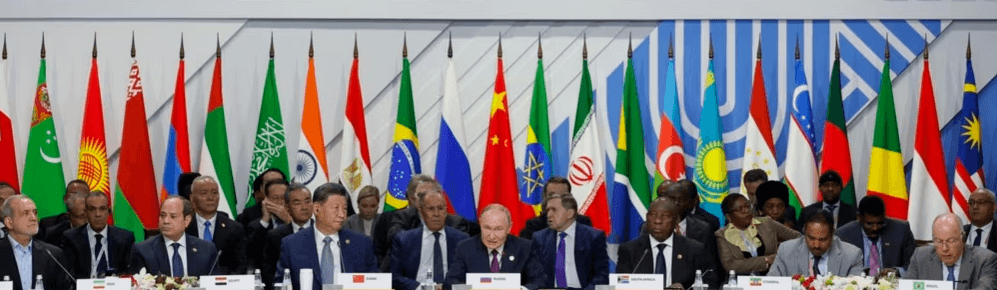
The recent BRICS summit in Kazan marks a pivotal moment in global geopolitics, especially as the group seeks to establish itself as a formidable economic and financial alternative to Western-led systems.
The discussions and agreements among Brazil, Russia, India, China, and South Africa reflect a growing consensus on the need for more autonomy and diversification of international financial mechanisms, signaling the potential for a new global order that may challenge traditional Western influence.
BRICS Summit Calls for Economic, Financial Autonomy
One of the key themes at the BRICS summit was the effort to reduce dependence on the U.S. dollar for international trade and financial transactions.
For decades, the dollar has been the dominant currency in global markets, a status that gives the U.S. significant influence over the global financial system.
The BRICS nations are now actively exploring ways to conduct trade in local currencies, which would not only lessen their exposure to U.S. sanctions but also help stabilize their own economies by reducing exchange rate volatility linked to the dollar.
China and Russia, in particular, have been outspoken advocates of this approach. With both countries facing sanctions and trade restrictions from the U.S., they are eager to find alternatives that could allow them to circumvent these economic pressures. By promoting financial cooperation within BRICS, they aim to build a system that is less vulnerable to Western interference, which would help protect their economic interests in an increasingly polarized global economy.
The proposal to create a BRICS digital currency has gained traction as a means to facilitate cross-border trade and investments between member countries without relying on the existing international financial system.
A digital currency could provide a secure and efficient platform for transactions while reducing the need for intermediaries like the U.S. Federal Reserve or the SWIFT payment network, which is heavily influenced by Western policies.
This initiative is particularly appealing to countries that have been affected by sanctions, such as Russia and Iran, and those that are looking for greater financial independence, like India and Brazil. If successful, a BRICS digital currency could offer an alternative to existing global currencies and payment systems, giving member countries more control over their economic destinies.
The BRICS nations have long expressed dissatisfaction with the dominance of Western financial institutions like the International Monetary Fund (IMF) and the World Bank. These institutions are often seen as vehicles for Western economic interests, imposing structural reforms and conditions that many developing countries find onerous. BRICS members are increasingly looking to establish alternatives that align more closely with their own development needs and priorities.
One of the outcomes of this push for financial independence is the establishment of the BRICS New Development Bank (NDB), which aims to provide an alternative source of funding for infrastructure and development projects in member countries and beyond. By providing loans without the stringent conditions typically associated with Western-led institutions, the NDB offers a more flexible and politically neutral approach to development finance, allowing BRICS countries to chart their own economic course.
India’s role within BRICS is particularly interesting given its complex geopolitical position. On one hand, India is a key player in the U.S.-led Indo-Pacific strategy, which seeks to counter China’s influence in the region. As a member of the QUAD, along with the U.S., Japan, and Australia, India has aligned itself with Western powers to bolster regional security and deter Chinese expansionism, especially in the South China Sea and the broader Asia-Pacific region.
Also read: Germany to Implement Strict Immigration Over Terror Attack
On the other hand, India’s relationship with China has been strained, particularly after the 2020 border conflict in the Himalayas. However, the recent meeting between Prime Minister Narendra Modi and Chinese President Xi Jinping on the sidelines of the BRICS summit suggests that both countries are now prioritizing stability over confrontation. This rapprochement, driven in part by India’s need to focus on domestic economic growth and China’s interest in reducing tensions with a key regional player, could lead to a rebalancing of India’s foreign policy.
The BRICS summit highlighted the growing divide between the Global South and the West. BRICS nations are increasingly positioning themselves as leaders of a multipolar world, where no single power—whether the U.S. or Europe—dominates global affairs.
This vision resonates with many developing countries that feel marginalized by Western-led institutions and policies. By promoting financial cooperation, technological innovation, and mutual respect, BRICS aims to offer a viable alternative to the Western-centric global order.
The rhetoric from Russian officials during the summit, particularly the comments by State Duma Speaker Vyachaslav Volodin, underscores this sentiment. Volodin’s assertion that the “time of the hegemony of Washington and Brussels is passing” reflects a desire among BRICS nations to assert their sovereignty and build a more balanced global system.
Despite the ambitious goals of BRICS, U.S. officials, including White House Press Secretary Karine Jean-Pierre, have downplayed concerns that the group poses a geopolitical threat. From Washington’s perspective, BRICS is seen primarily as an economic partnership, rather than a direct competitor to the U.S. and its allies.
However, as BRICS continues to grow in influence and explores ways to decouple from Western systems, the U.S. may need to reassess its approach. The rise of BRICS could complicate U.S. efforts to maintain its global leadership, particularly if more countries in the Global South begin to align with BRICS’ goals of financial autonomy and multipolarity.