
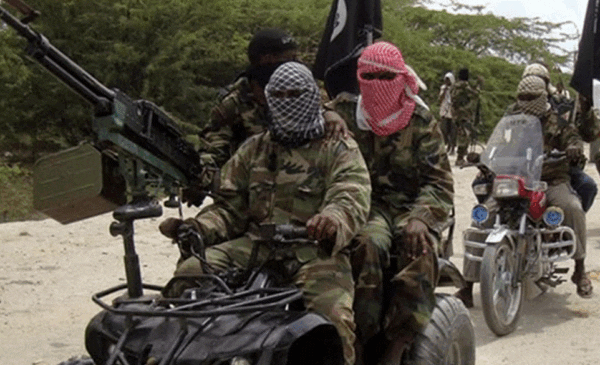

In a disturbing development, Governor Babagana Zulum of Borno State expressed serious concern over the recent Boko Haram attack on Kirawa town in Gwoza Local Government Area. The assault, which resulted in two deaths and many displaced residents, took place shortly after Cameroonian troops left the area. This withdrawal created a security gap that the insurgents exploited. The governor stated that he had previously warned the Nigerian military about the risks of leaving the border community unprotected, but his concerns were ignored.
Governor Zulum Decries Renewed Boko Haram Attacks
Governor Zulum emphasized that Kirawa and other border towns, such as Baga, Damasak, and Malamfatori, are crucial for Nigeria’s security and should always receive protection. He felt frustrated that, despite his repeated warnings, the Nigerian military did not act in time. “I informed the Nigerian military about the dangers of leaving this town vulnerable. Unfortunately, my request did not get the necessary attention, and the insurgents came on Wednesday to destroy everything we worked so hard to rebuild,” Zulum lamented.

The Boko Haram attack led to the destruction of over 50 houses, several heavy-duty vehicles, and essential infrastructure in the town. While only two lives were lost, Zulum noted that the material damage was significant. He mentioned that the Nigerian Army has agreed to send soldiers back to Kirawa, and the state government would assist local defense groups with logistics and equipment to prevent future assaults.
Also Read: Atiku Abubakar Shuts Down Rumors of Stepping Down for 2027 Presidential Race
In a display of leadership, the governor personally organized members of the civilian JTF and troops to restore order in the community. He stressed the importance of boosting the local defenders’ morale and promised to provide them with more weapons and protective gear. According to Zulum, these efforts are crucial to ensuring that Boko Haram does not easily attack communities in the state.
Governor Zulum also called on the federal government to release funds to reinforce security operations in Borno. He urged the Chief of Defence Staff to speed up the procurement of military equipment and ensure a constant military presence in vulnerable areas. “We are asking the federal government to release funds and buy equipment so that military operations can start in full swing as the rainy season is ending,” he said.
The governor emphasized that the Nigerian military needs to show a stronger commitment to fighting Boko Haram. He pointed out that the number of soldiers is less important than their dedication and response time during attacks. “I’m also asking the Nigerian military to be more committed because what matters is not how many soldiers there are but how willing they are to fight during military operations,” Zulum stated.
He also cautioned that irregular or inconsistent military operations contributed to the resurgence of Boko Haram. He explained that a lack of sustained offensives in certain areas has encouraged the insurgents to carry out new attacks. “At times, military operations were not carried out for long stretches in Borno, and that has played a role in the renewed Boko Haram attacks we are seeing now,” he added.
Despite the tension, Zulum assured residents of Kirawa and nearby communities that his administration remains dedicated to their safety. He urged them not to panic but to stay united and alert. “You need not panic. I see no reason why a small group of Boko Haram members should be able to defeat the entire community without resistance,” he said.
In the meantime, reports indicate that over 5,000 residents fled across the border into Cameroon after the attack. The district head of Kirawa, Abdulrahman Abubakar, confirmed that Boko Haram fighters took control of the area, setting homes, a military barracks, and his palace on fire. The insurgents later released a video celebrating their victory, chanting “victory belongs to God” as they burned the town.
The latest Boko Haram offensive serves as another reminder of the ongoing insecurity in Nigeria’s northeast, despite years of counterinsurgency efforts. There are renewed calls for better cooperation between federal forces, local vigilantes, and regional partners, raising hopes that peace will eventually return to Borno State and other conflict-affected areas.